
Best 100-mile races for first-timers: A runner's guide to your debut 100

By Henry Howard
The 100-mile distance is, without question, one of the most transformative challenges in endurance sports. Crossing that finish line, regardless of what the clock reads, changes how you see yourself and what you believe you are capable of achieving.
I’ll always remember my first 100-miler, Rio del Lago. Upon completing that race, thanks to an amazing crew, I knew that I could handle hard races that once seemed insurmountable. Since Rio in November 2019, I have completed four more 100-milers, bringing the total number of marathons and ultras I have finished to nearly 50.
Runners curious about ultras wonder what are the best 100-mile races for first-timers. Too technical, too hilly, or too remote, and a first-timer can quickly find themselves overwhelmed before the real battle even begins.
The best races for first-time 100-milers tend to share a few characteristics: manageable elevation, well-stocked and closely spaced aid stations, crew-accessible courses and a community-driven atmosphere that carries you through the dark miles. I’ve picked out 12 races (plus a bonus one) that check most or all of those boxes. They span the country — from the flat rail trails of Illinois and Ohio to the scenic mountains of Oregon and Virginia — offering options for every runner’s geography, schedule and personality.
Note: I have run and written about several of these races on RunSpirited.com. Where that is the case, I have included links to those posts. Nothing beats firsthand experience, and I hope these accounts give you an honest picture of what awaits.
(Like my work? I'd be honored if you'd support me. Consider a donation of any amount, such as a cup of coffee.)
What is the best 100-mile race for a first-timer? 12 expert picks

1. Badger Trail 100 — Belleville, Wisconsin / Orangeville, Illinois
When: Early August | Course type: Out-and-back on rail trail | Difficulty: Low
If flat and non-technical is what you need for your first 100, the Badger Trail 100 is hard to beat. The course runs along the Badger State Trail and Jane Addams Trail between Belleville, Wisconsin and Orangeville, Illinois — 99% rail trail, nearly zero asphalt, and almost entirely straight. You will not get lost. The 100-mile distance covers the route south-to-north, then turns around and heads south again, with the finish line at a community park in Belleville.
Aid stations are spaced every 4 to 8 miles and alternate between crew-accessible and non-crew stops, making logistics straightforward. One beloved highlight: the northernmost aid station at Dot’s Tavern, a dive bar atmosphere where runners are encouraged to duck inside and grab a commemorative coaster — and perhaps a quick beer at mile 35. The race has a 36-hour cutoff and offers distances from half marathon through 100 miles across the same weekend.
First-timers consistently highlight how approachable the course feels. As one runner wrote after completing it as their first hundo: the rail trail format made it “pretty difficult to get lost” and crew access was exceptionally easy, with crew able to park close to the course and set up right alongside the route.
Race website: tenjunkmilesracing.com
2. Canal Corridor 100 — Akron, Ohio
When: Mid-October | Course type: Out-and-back on Towpath Trail | Difficulty: Low (only ~807 feet of elevation gain)
Billed by its organizers as “fast, flat, scenic, and inclusive,” the Canal Corridor 100 runs along the Ohio and Erie Canalway’s historic Towpath Trail through Cuyahoga Valley National Park and beyond, one of the most beautiful urban-edge trail systems in the country. Starting and finishing at Missing Falls Brewery in downtown Akron, the course travels north and south on the Towpath, which is roughly 70% crushed limestone and 30% asphalt. With only about 807 feet of total elevation gain across 100 miles, this is one of the flattest 100-milers in the country.
Race organizers explicitly designed this event to be accessible to first-timers. Aid stations are staffed by experienced ultra runners who go beyond the basics. There is a 30-hour cutoff. The race is also a Western States qualifier, so a finish here carries real credential value. Profits are donated to trail conservation nonprofits in the region, giving participants a meaningful cause to run for.
Race website: seotrevents.com/canalcorridor

3. Dinosaur Valley 100 — Glen Rose, Texas
When: Just before Thanksgiving in November | Course type: Multi-loop (10.5-mile loops) | Difficulty: Moderate (some rocky singletrack)
Set inside Dinosaur Valley State Park — yes, the one with actual dinosaur tracks in the riverbed — the Dinosaur Valley 100 is a loop-based race with a festive, community-driven atmosphere. The 100-mile course consists of loops on a 10.5-mile circuit combining singletrack trail and rocky terrain. The rocks, which are toward the end of the loop, deserve your full attention, especially when it is dark outside. The 100-miler is a Western States qualifier.
The start-finish area buzzes with music, crew activity and outstanding volunteers who bring genuine enthusiasm to every lap. The flagging is exceptional at night — pink flags with small reflectors that light up in your headlamp — so getting lost is not a major concern. Race director Libby Jones and The Active Joe team have built a reputation for a runner-first experience, including a community-minded ethos: the 2023 event donated $4,000 to the park for emergency rescue equipment.
I ran the 100K version of this race in 2025 and wrote a review about the awesome experience. The rocky terrain keeps you honest, but the loop format means you are never far from support, and the atmosphere makes the miles feel lighter.
Race website: theactivejoe.com | My 100K race recap on RunSpirited: Dinosaur Valley 100K Race Recap
4. Hennepin Hundred — Dixon, Illinois
When: Early October | Course type: Out-and-back on canal path | Difficulty: Low (~1,000 feet of gain)

The Hennepin Hundred is one of my favorites, even though I DNF’d once but finished the first two times I raced it. Hennepin is one of the flattest 100-milers in existence, with only about 1,000 feet of elevation gain over the entire course, which runs along a canal path in northern Illinois. For runners who live and train in flat terrain (hello, Midwest), this is the rare race that does not punish you for your geography.
Race director Michele Hartwig and her Ornery Mule Racing team put on an exceptionally well-organized event. There are 20 aid stations over the 100-mile course — meaning you are almost never far from support. Volunteers are enthusiastic and attentive, and crew access is available at the majority of stops. The course is well marked, communications leading up to race day are outstanding, and the flat, fast surface lets first-timers focus purely on pacing and fueling. Hennepin is a Western States qualifier.
My second 100-miler was Hennepin, and the contrast with my hilly debut at Rio del Lago was stark. Hennepin’s manageable terrain let me run more confidently and focus on the process.
Race website: ornerymule.com/hennepin-hundred | My race writeups on RunSpirited: Hennepin Hundred Race Review, Five Reasons to Run Hennepin
5. Indiana Trail 100 — Albion, Indiana
When: Mid-October | Course type: Four 25-mile loops | Difficulty: Moderate (~6,000 feet of gain)
Held at Chain O’Lakes State Park in northern Indiana, the Indiana Trail 100 is the only 100-mile trail race in the state. The non-profit event benefits the park itself. The course consists of four 25-mile loops through wooded singletrack, rolling grasslands, and scenic views of glacial lakes, with roughly 1,500 feet of gain per loop and about 6,000 feet total. That is enough of a challenge to feel real, but manageable enough for a prepared first-timer.
The IT100 is celebrated for its volunteer culture and community spirit. Aid stations are spaced 3 to 5.5 miles apart and well-stocked, with medical support on course. The loop structure means you pass through the start-finish area multiple times, making crew logistics simple. It is a Western States qualifier. The race fills up so register early.
Race website: ignitetrailseries.com
6. Javelina Jundred — McDowell Mountain Regional Park, Arizona
When: The weekend before Halloween in October | Course type: Loop-based in the Sonoran Desert | Difficulty: Low-moderate (flat but exposed)

Few 100-milers have the festive reputation of Javelina Jundred. Run in the Sonoran Desert outside Fountain Hills, Arizona, it features a loop-based course that is relatively flat and non-technical — but heat and sun exposure are genuine factors in late October. Runners pass through the main hub multiple times per loop, and each lap includes a stop at the legendary “dance floor” aid station, where the party never really stops. Crew and pacers have easy access throughout the race.
The atmosphere is genuinely unlike any other 100-miler. If you want your first 100 to feel like a community celebration with great costumes and a vibrant energy, Javelina delivers. The tradeoff is the desert environment: heat management and sun protection are non-negotiable, and the course can feel relentless under a midday sun. Hydration and electrolyte discipline will matter more here than at most first-timers’ races on this list.
If interested in Javelina, register early. The race will sell out and have a long wait list.
Race website: aravaipafunnels.com/javelina-jundred
7. Mountain Lakes 100 — Olallie Lake, Oregon
When: Mid-September | Course type: Out-and-back with loops on the PCT | Difficulty: Moderate-challenging (~11,700 feet of gain)
Mountain Lakes 100 is the most scenically ambitious race on this list. Many race finishers believe it is one of the most beautiful 100-milers in the country. Starting and finishing at Olallie Lake in the Oregon Cascades, 60 of the 100 miles follow the Pacific Crest Trail between Mt. Jefferson and Mt. Hood. The course passes dozens of alpine lakes, runs through technical and rocky sections and rewards runners with mountain views in every direction. Fall foliage in September can be extraordinary.
The race is remote — expect no cell service, rough access roads and a wilderness feel throughout. Go Beyond Racing, which produces the event, is known for exceptional organization and volunteer support that runners consistently describe as the most attentive they have encountered. Registration is first-come, first-served (no lottery), but note that all entrants must complete 8 hours of trail work before race day — a meaningful requirement that gives back to the trails you run on.
With nearly 12,000 feet of gain, this is the most challenging entry on this list technically and physically — but multiple first-timers have pointed to Mountain Lakes as their race of choice precisely because they wanted spectacular scenery and outstanding support, not just a flat course to survive. It is a Western States qualifier.
Race website: gobeyondracing.com
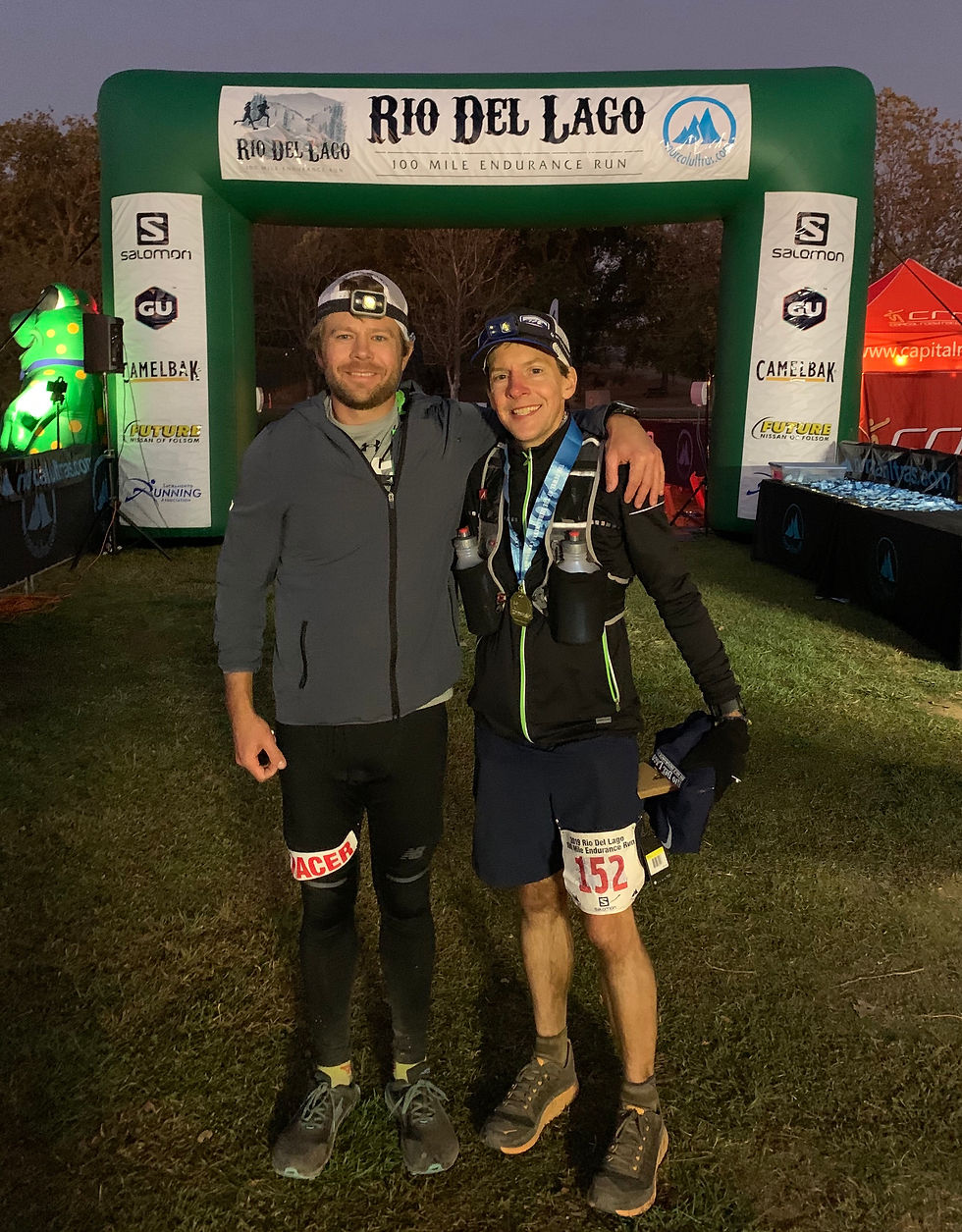
8. Rio del Lago 100 — Granite Bay (Folsom), California
When: Early November | Course type: Out-and-back on Sierra foothills trails | Difficulty: Moderate (~8,200 feet of gain)
Rio del Lago was my first 100-miler — and it will always hold a special place in my heart. Starting at Beal’s Point on Folsom Lake about 40 minutes east of Sacramento, the course traverses oak woodland, lakeside singletrack, bridges and creek crossings, switchbacks, and — memorably — a stretch of the legendary Western States trail near Auburn. The race is on a beautiful course, well-organized and manages to be manageable for first-timers while still feeling like a real mountain adventure.
Race director Julie Fingar and the Nor Cal Ultras team run a first-class event. There are 17 aid station visits over the course, with crew access at six of them. The 30-hour cutoff is generous. The final 20 miles include some rocky, technical terrain, so it is not fully “easy” — but the first-timer community consistently recommends it for its balance of challenge, beauty and support. It is also one of the last Western States qualifiers on the calendar each year.
Race website: rio100mile.com | My race recap on RunSpirited: Running 100 Miles With a Little Help From My Friends
9. Rocky Raccoon 100 — Huntsville, Texas
When: Early February | Course type: Five 20-mile loops | Difficulty: Low (~6,800 feet of gain)
Rocky Raccoon is a perennial recommendation for first-time 100-milers — and for good reason. Held in Huntsville State Park in east Texas, the course consists of five 20-mile loops through pine forest on relatively smooth singletrack with about 6,800 feet of total elevation gain. The terrain is entirely runnable, which allows a first-timer to focus almost exclusively on pacing, nutrition, and managing the distance — rather than technical footing.
Running in February means cooler temperatures for most of the day, though humidity can be a factor in the Texas pines. The loop structure is psychologically helpful for some (you know exactly what is coming) and challenging for others (you see the start-finish area multiple times before you are done). Aid station access is frequent and crew logistics are straightforward. Rocky Raccoon also serves as an UTMB Series qualifier.
Race website: trailracing.com/rocky-raccoon-100-mile
10. Tunnel Hill 100 — Vienna, Illinois
When: Mid-November | Course type: Out-and-back on rail trail | Difficulty: Very low (minimal elevation gain)

Tunnel Hill is often regarded as one of the fastest and most accessible 100-milers in the country. Run on the Tunnel Hill State Trail, a former railroad corridor through the Shawnee National Forest, the course is non-technical, almost entirely flat and strikingly beautiful in mid-November when the hardwood forest has turned.
The course features a historic railroad tunnel that runners pass through twice — a memorable touchstone in an otherwise straightforward route. Aid stations are frequent, and the race has a well-deserved reputation for smooth organization. For runners looking to set a fast time on their first 100 — or simply get through it without fighting technical terrain — Tunnel Hill is a top choice. It frequently produces course records and first-time finishes in the same race.
Race website: tunnelhill100.com
11. Umstead 100 — Raleigh, North Carolina
When: Early April | Course type: Eight 12.5-mile loops | Difficulty: Low-moderate (non-technical gravel roads)
Umstead 100 is one of the most respected first-timer races in the country, and for good reason. Held inside William B. Umstead State Park just outside Raleigh, North Carolina, the course consists of eight 12.5-mile loops on well-groomed gravel roads through hardwood forest. The terrain is consistent and non-technical. There are no creek crossings, no boulder fields, no route-finding challenges. You simply put your head down and run.
What truly sets Umstead apart is its volunteer culture. The race is famous for its experienced, attentive volunteers — and its unique “volunteer pacers” program, where runners in the latter stages of the race can be joined by volunteer pacers who help them through the critical miles between laps six and eight. For a first-timer who may not have a personal pacer available, this is invaluable support. The loop format also means your crew can see you every 12.5 miles without any logistical complexity.
Race website: umstead100.org
12. Vermont 100 — South Woodstock, Vermont
When: Mid-July | Course type: Point-to-point (dirt roads and horse tracks) | Difficulty: Low-moderate | Note: Requires qualifying time for entry
The Vermont 100 is one of the oldest and most beloved 100-milers in America, and frequently cited as one of the most beginner-friendly despite its storied history. The course rolls through Vermont’s pastoral countryside on dirt roads, horse tracks and gentle trails. There are not any major technical climbs or daunting elevation sections. The scenery, especially in July’s green Vermont summer, is spectacular.
The race is run in conjunction with a 100-mile horse endurance race on the same course, creating a unique and memorable shared experience. Aid stations are plentiful and well-stocked, and the community atmosphere is warm and deeply supportive of first-timers.
One important caveat: Vermont 100 requires qualifying times for entry, so it is typically better suited as a first 100 for runners who already have some serious ultra experience at the 50-mile distance or beyond. Check the race website for current qualifying standards.
Race website: vermont100.com
Bonus: Yeti 100 — Abingdon, Virginia
When: Late September/Early October | Course type: Point-to-point on the Virginia Creeper Trail | Difficulty: Low-moderate (rails-to-trails)

The Yeti 100 runs on the Virginia Creeper Trail — America’s only National Scenic Rails to Trail designation — through the Appalachian mountains of southwest Virginia. The course is accessible, crew-friendly throughout and nestled in one of the most beautiful trail corridors in the eastern United States.
The section between Whitetop and Damascus is a wide dirt and gravel trail through a lush green tunnel above a rushing mountain stream, crossing well-laid trestle bridges. It makes for a memorable part of the race.
The race was born from Appalachian roots and has a deeply community-driven ethos. Veteran runners actively mentor first-timers, aid station volunteers become trail family, and the race organization is known for meticulous care and welcoming inclusivity. Multiple runners have specifically chosen Yeti as their debut because they wanted a race where they could focus on the miles — not river crossings, boulder fields, or navigation challenges. Requires a qualifying 50-mile finish.
Race website: yetitrailrunners.com
Final thoughts: The 'best' first 100-miler
There is no single “best” first 100-miler. The best one for you is the one that fits where you are as a runner, will excite you to get out and do the training, and deliver the experience you crave.
I recommend to my athletes to pick races that inspire them, provide that motivation to get out and train even when the weather or other factors are telling your brain “no.” For a 100-miler, it’s even more critical for the race to serve as a motivator.
If you live in flat terrain and want a confidence-building debut, Hennepin, Tunnel Hill, Canal Corridor, or Badger will serve you well. If you want something with more personality and atmosphere, Javelina or Yeti offer unforgettable experiences. If spectacular scenery matters above all else, Mountain Lakes and Rio del Lago are hard to beat.
Whatever you choose: respect the distance, train specifically for the terrain, build your crew and pacing plan early, and remember your “why” when the miles get dark. The finish line awaits. And when you cross it, everything changes.
About the author: Henry Howard is an ultra runner, running coach, and founder and Chief Running Officer of RunSpirited.com. He has completed five 100-mile races including Rio del Lago and Hennepin Hundred, compiled multiple podium finishes at ultras and marathon races, and coached athletes to successful ultra and marathon achievements.
Frequently Asked Questions: Best 100-mile races for first timers

Question: What is the easiest 100-mile race for a first-timer?
Answer: If ease of terrain is the priority, Tunnel Hill 100 in Vienna, Illinois, is widely regarded as the most accessible. It is a flat, non-technical out-and-back on a former railroad corridor through Shawnee National Forest with minimal elevation gain. The Hennepin Hundred in Illinois (only 1,000 feet of gain over 100 miles on a canal path) and the Canal Corridor 100 near Akron, Ohio (807 feet of gain on the historic Towpath Trail) are close seconds. All three let first-timers focus entirely on pacing and fueling rather than technical footwork.
Question: Do I need to qualify to enter a 100-mile race?
Answer: It depends on the race. Many first-timer-friendly 100-milers — including Tunnel Hill, Canal Corridor, Badger Trail and Indiana Trail 100 — have no formal qualifying requirement beyond general fitness and a completed registration. Others require evidence of prior ultra experience: the Yeti 100 asks for a completed 50-miler, and the Vermont 100 requires specific qualifying times. A small number use a lottery system. Always check the race's official website well in advance, as requirements can change year to year.
Question: How long does it take to finish a 100-mile race?
Answer: Finishing times for first-timers typically range from 24 to 30 hours, though there are many variables such as the course, runner fitness level, weather conditions and much more. Many races have cutoffs of 30 to 36 hours. The average finish time across all runners at flat, beginner-friendly events is often in the 26 to 28 hour range. Elite runners can finish in 12 to 16 hours. What matters most for a debut is not speed but consistent pacing, disciplined nutrition and managing the inevitable rough patches — usually kicking in somewhere between miles 60 and 80.
Question: How much training do I need before running my first 100-miler?
Answer: Most coaches recommend at least one completed 50-miler or 100K — preferably two or more — before attempting 100 miles. A solid training base of 50 to 70 miles per week at peak, built over 6 to 12 months, is a reasonable foundation. Training should be specific to the race: if your target course is flat, practice running on similar terrain at long efforts; if it has significant elevation, incorporate sustained climbs even if you have to travel to find them. Beyond mileage, practice time on feet, night running, and eating while moving. For races with elevation change, I recommend my athletes do treadmill power hiking in addition to the running workouts. These skills that matter as much as fitness on race day.
Question: What should I look for in a beginner-friendly 100-mile race?
Answer: The most important factors are: (1) manageable elevation gain — ideally under 10,000 feet for a first attempt; (2) frequently spaced aid stations; (3) crew-accessible course so your support team can reach you regularly; (4) a generous time cutoff of at least 30 hours; and (5) a reputation for strong volunteer support. Loop and out-and-back courses are also psychologically helpful for first-timers to prevent going off course and to make it easier for your crew. Races with an active community and experienced race directors are worth prioritizing. After all, a well-run event makes an enormous difference when things get hard.
Question: Can I walk a 100-mile race?
Answer: Yes, and many first-timers walk significant portions of the race. In fact, at my first Hennepin, a person at the start line told me his plan was to walk all of it because he was injured. Very few elites run every step of a 100-miler. For most runners, a run-walk strategy is not just acceptable, it is often the smartest approach for covering 100 miles. Like many ultra coaches, I recommend walking the uphills starting early in the race to conserve muscle strength for the later miles. Even flat courses benefit from intentional walk breaks around aid stations. The goal of a first 100-miler is to finish, not to run every step. Races like Rocky Raccoon, Tunnel Hill and Canal Corridor are popular with first-timers who plan a deliberate run-walk approach from the start.
Question: What is a Western States qualifier and why does it matter?
Answer: The Western States Endurance Run is the most prestigious 100-mile race in the world, held each June in California's Sierra Nevada mountains. For non-elites entry is by lottery, and to enter the lottery you must first complete a designated qualifying race within a set time window. Many of the races on this list — including Canal Corridor, Hennepin Hundred, Indiana Trail 100, Dinosaur Valley 100, Mountain Lakes and Rio del Lago — are official Western States qualifiers. For runners with long-term aspirations of reaching the Western States start line, choosing a qualifying race for your first 100 means your debut does double duty.


Comments